
An AI explorer that predicts the most likely origin of a name: region, sub-region and country, each with a confidence score and a second-best answer. I designed it to show uncertainty honestly instead of hiding it behind one verdict. I led UX and UI end to end.
Case study 06 · AI name origin
Where a name comes from,
and how sure the model is.
My role
Lead UX and UI designer
Scope
Research, IA, UX, UI, design-to-code
Platform
Web, English and Arabic
Sector
Public sector, under NDA
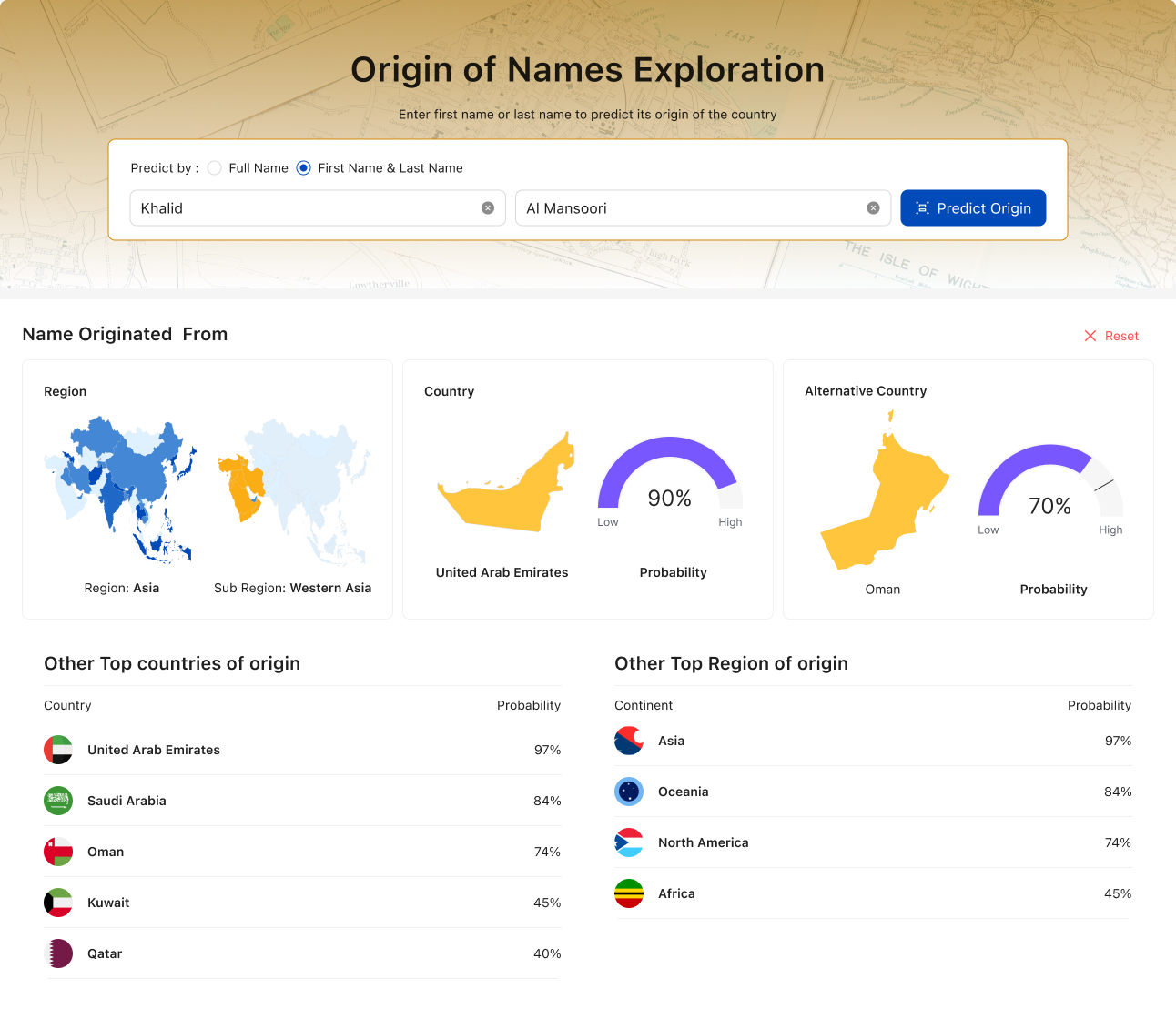
01 · Snapshot
One name in,
a clear answer out.
Problem
A single answer hid the doubt
Names travel across countries and scripts. A model that names one country with no confidence invites too much trust.
What I did
Turned a prediction into an explanation
Search patterns, a broad to precise result layout, confidence gauges, ranked alternatives and a bilingual UI.
Outcome
Answers people can weigh
Every result shows where, how sure and what else, in one view.
3
levels of origin: region, sub-region and country
5
ranked alternative countries for every name
2
ways to search: full name, or first and last name
02 · The problem
One name, many spellings.
One answer is never enough.
The same name is written many ways across languages and scripts, and many names are common in several countries at once. A model that returns a single country with no confidence invites people to trust it more than they should.
First name · Last name · Full name · Spelling variants · Arabic and Latin script → Origin with confidence
01
Where is it from?
Region, sub-region and country, from broad to precise.
02
How sure is it?
A confidence score next to every answer, never hidden.
03
What else could it be?
A second country and a ranked list, not one verdict.
The question behind every search
Where is this name from, and how sure are you?
03 · The use case
From a typed name
to a clear answer.
A user types a full name, or a first and last name separately. The model compares it with known naming patterns and returns the most likely origin, from continent down to country, with how confident it is and what the alternatives are.
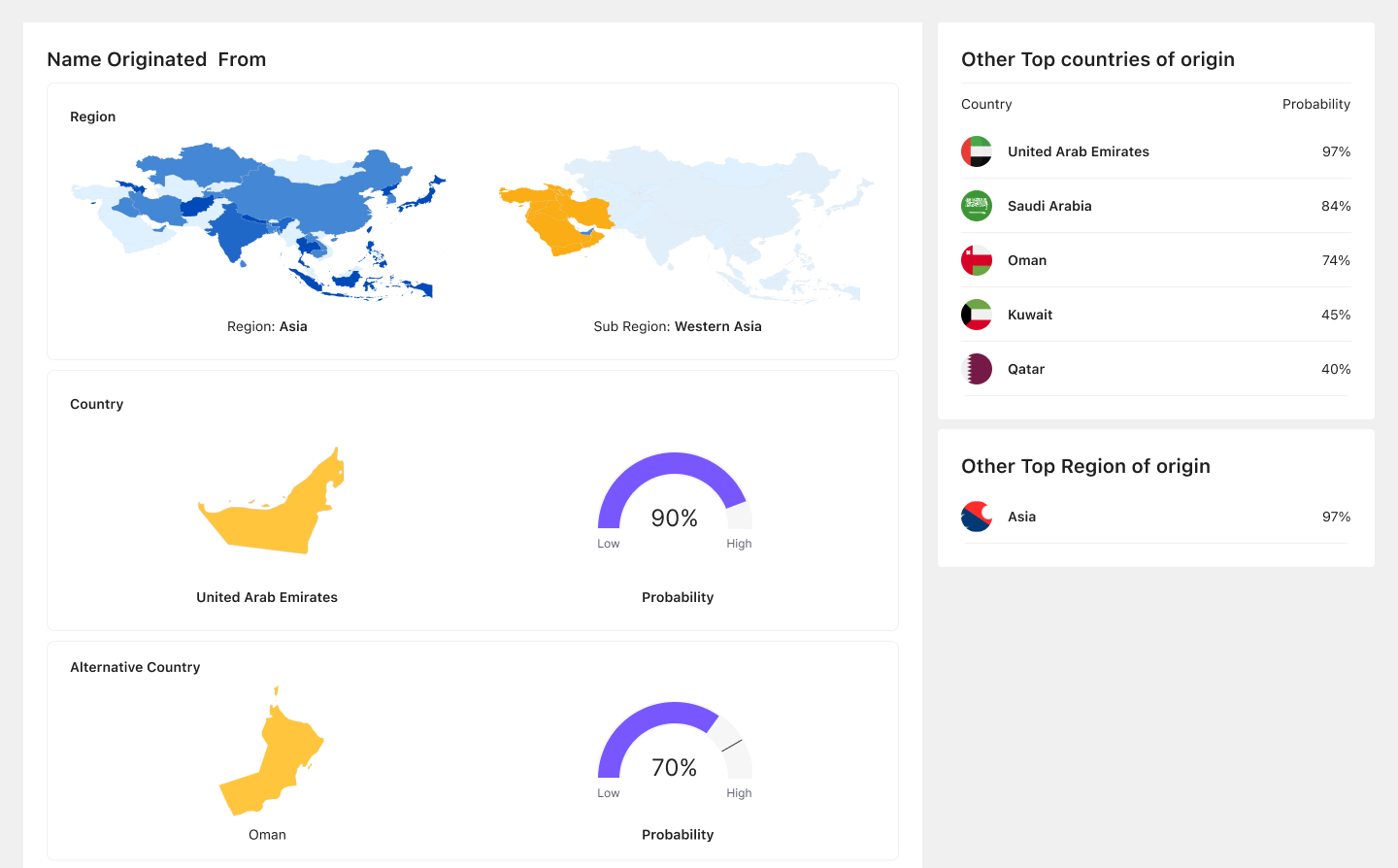
Screen · Detail view · Sample data
How a search flows
01
Choose how to search
Full name, or first and last name in separate fields.
02
AI predicts the origin
Region, sub-region and country, each with a probability.
03
Confidence in plain sight
A low to high gauge beside the main and the alternative country.
04
Explore the alternatives
Top countries and top regions, ranked by probability.
A plain prediction
One country, no reason
No sense of how sure the model is
Close second choices hidden
Searches lost after each lookup
With the explorer
Region, sub-region and country together
A confidence gauge on every answer
An alternative country and a ranked top five
Recent searches one click away
The model suggests an origin. People make the call.
04 · Key decisions
Four choices that keep
the AI honest.
01
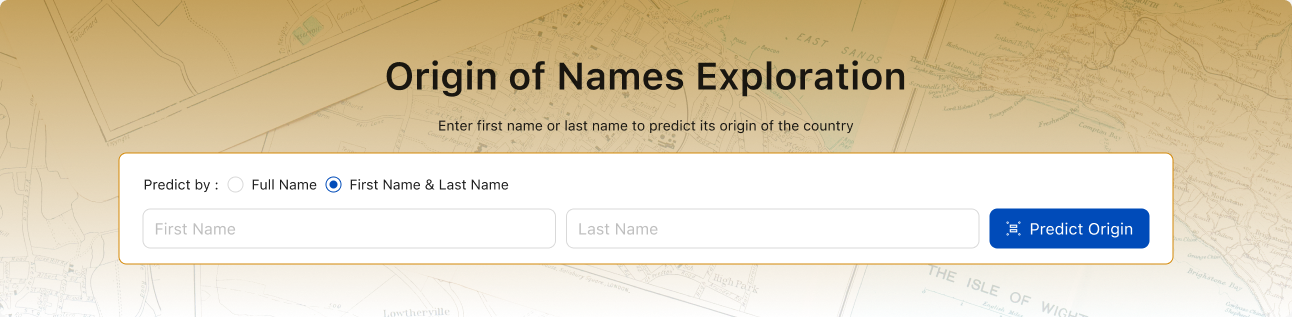
Two ways to search
I saw
People hold names differently, and some only know part of one.
I chose
Full name in one field, or first and last name in two, chosen with a single switch.
02
Broad to precise
I saw
A weak country guess can still carry a strong regional signal.
I chose
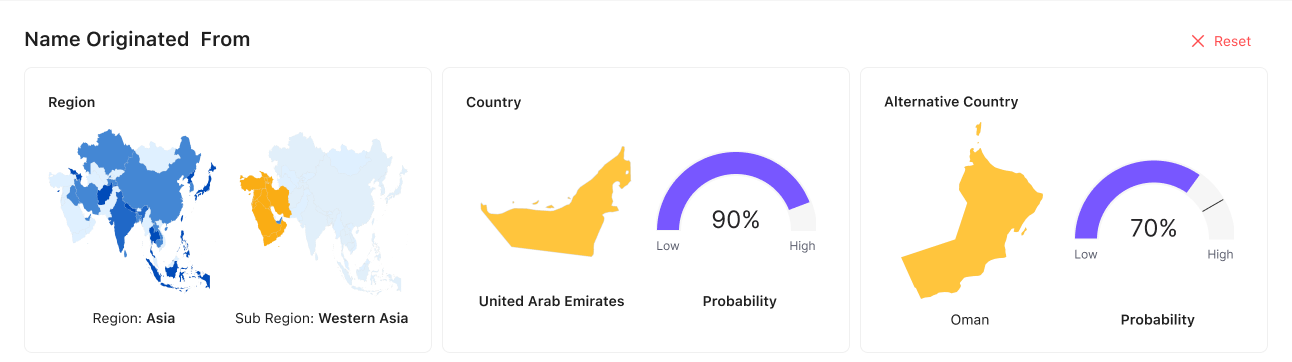
Region, then sub-region, then country, each on its own map, so the answer is useful at every level.
03
Confidence beside every answer
I saw
A percentage on its own was easy to misread as certainty.
I chose
A low to high gauge sits next to the main and the alternative country, so 70% looks like 70%.
04
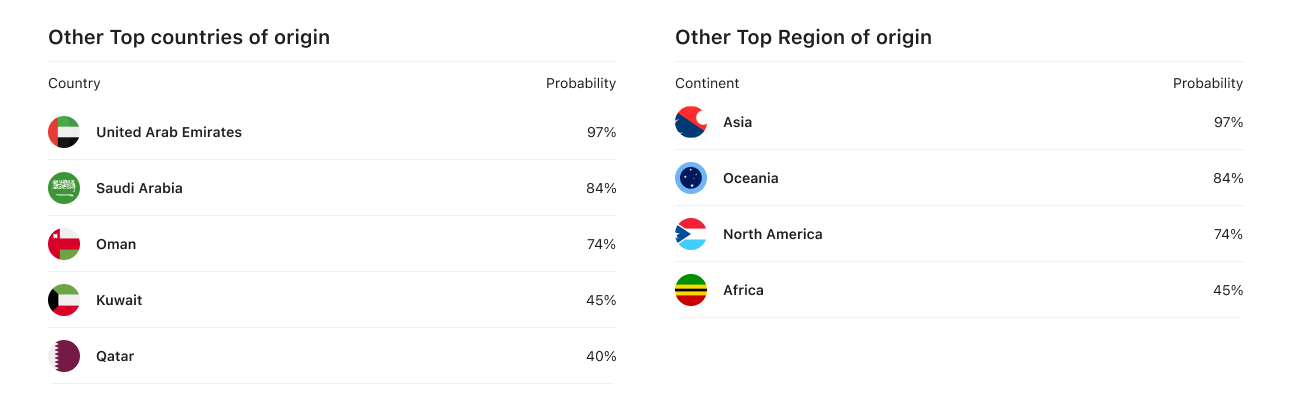
Always an alternative
I saw
A single verdict hid close second choices.
I chose
A second country plus ranked top countries and regions make it clear the model suggests, it does not decide.
05 · Design details
Built to be read,
not decoded.
Each part of the result answers one question. Maps show where, gauges show how sure, ranked lists show what else, and the same view works in English and Arabic.
Sub region
Western Asia
Region · Asia
المنطقة الفرعية
غرب آسيا
المنطقة · آسيا
Components
Search switch · Name fields · Region map · Country map · Confidence gauge · Ranked list · Recent searches · Detail view
Accessibility
Colour plus words
Every map has a written label, so meaning never depends on colour.
Arabic
Mirrored, not translated
Layout, maps and gauges flip right to left with the language.
Clarity
One question per card
Where, how sure and what else, each in its own place.
06 · What it delivered
From a black-box guess
to an answer people can weigh.
What I would do differently
Explain which part of the name drove the answer.
Showing whether the first or the last name carried the prediction would make each result easier to question, and easier to trust.
What I would keep
Show the doubt.
An answer with its confidence and a second choice is more honest than any single percentage.
Next
There is more to this work
than fits on a page.
I walk through the full flows, the research and the trade-offs in a private session.
Client, data and identifying details are withheld under NDA. Screens use sample data.