

Should AI do the whole job, or just help with it?
Most teams treat this as an either/or choice. In practice, it’s not. It’s a spectrum, and knowing where a task fits changes how you build your product.
Two questions decide where a task belongs:
- How costly is a mistake?
- How routine and predictable is the work?
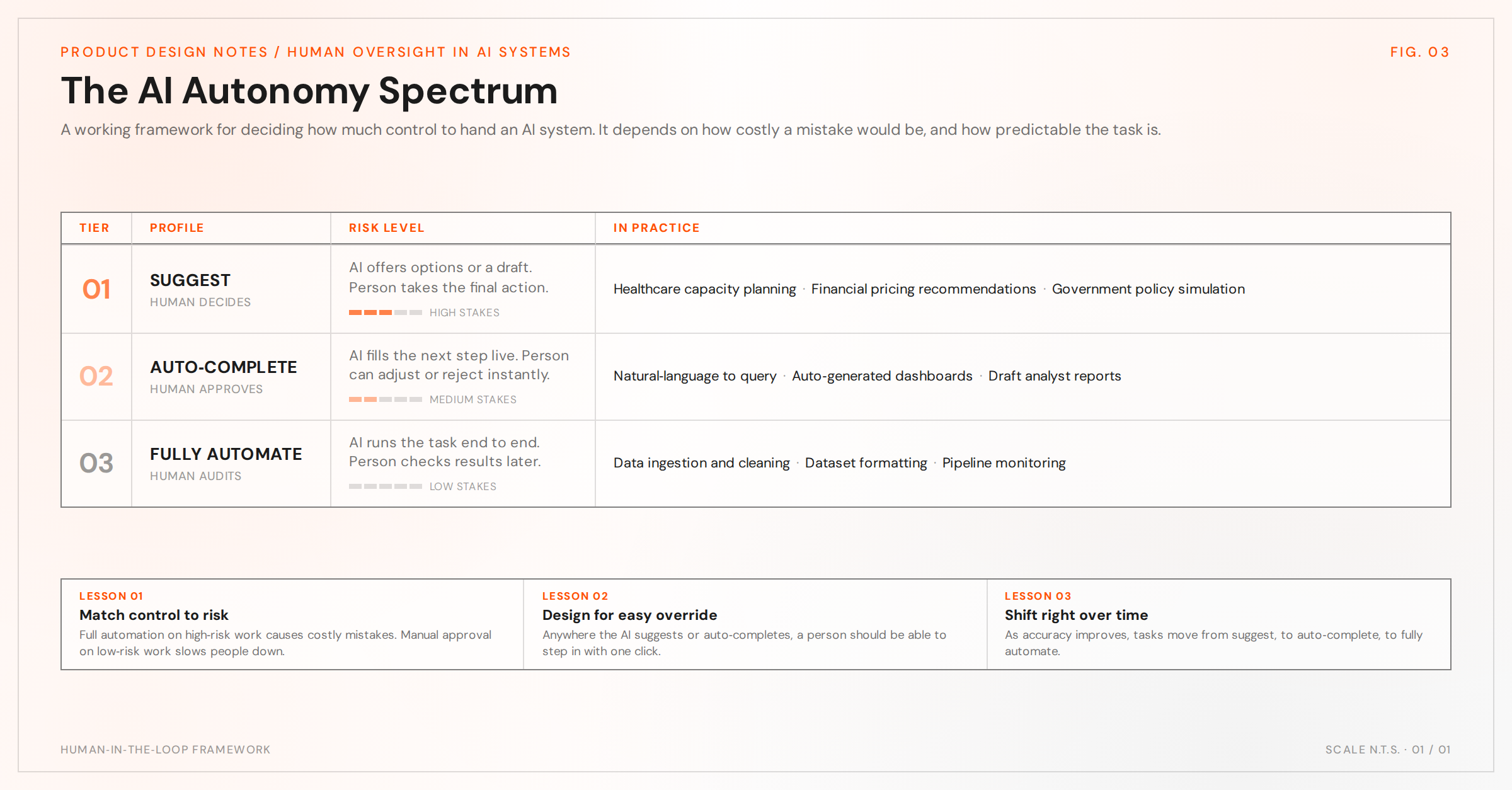
Here’s a simple way to think about it, in three levels.
Suggest
For high stakes, judgment-heavy work. The AI offers ideas or drafts. The person decides and takes the final action. Think healthcare capacity planning, financial pricing recommendations, or government policy simulation.
Auto-Complete
For medium stakes, fairly predictable work. The AI fills in the next step in real time. The person watches and can accept, tweak, or reject it instantly. Think natural language to query conversion, auto-generated dashboards, or draft analyst reports.
Fully Automate
For low stakes, highly repetitive work. The AI handles the task from start to finish. The person just checks in later. Think data ingestion and cleaning, dataset formatting, or routine pipeline monitoring.
A few lessons worth keeping in mind
Match control to risk. Full automation on high-risk decisions causes anxiety and costly mistakes. Manual approval on low-risk tasks just slows people down.
Make it easy to step in. Whenever AI suggests or auto-completes something, the person should be able to override it in one click.
Shift right over time. As AI gets more accurate, tasks can move from suggest to auto-complete to fully automate.
The goal isn’t more automation. It’s the right amount of automation for each task.
#ProductDesign #AI #HumanInTheLoop #UXDesign #ProductManagement
